
How to Search Westmoreland County Court Records
The main court records pathway for the county is the Pennsylvania Unified Judicial System portal, often called UJS. It is a free, statewide system that holds dockets for the Court of Common Pleas and the Magisterial District Courts. The county's own public record search page links out to UJS and to other official systems for deeds, tax assessments, and jail inmates. For most case lookups, the UJS Case Search and UJS Docket Sheets tools do the heavy lifting.
Know what you have before you start. A name, a docket number, or a citation number all work. A docket number is the most exact. Set the county to Westmoreland so common names do not pull back the whole state.
- Open the UJS Case Search or Docket Sheets tool on the Pennsylvania courts portal.
- Pick how you want to search: participant name, docket number, citation number, or date filed.
- For a name search, set the county to Westmoreland to narrow the list.
- For a docket number, type the full code. Common Pleas criminal dockets read like CP-25-CR-0009999-2017; magisterial dockets begin with MJ.
- Open the docket sheet to read parties, charges or claims, hearings, bail, and the list of filings.
The county also gathers its official record links in one place. The Westmoreland County public record search hub sends you to court, deed, assessment, and inmate systems without guessing at web addresses.
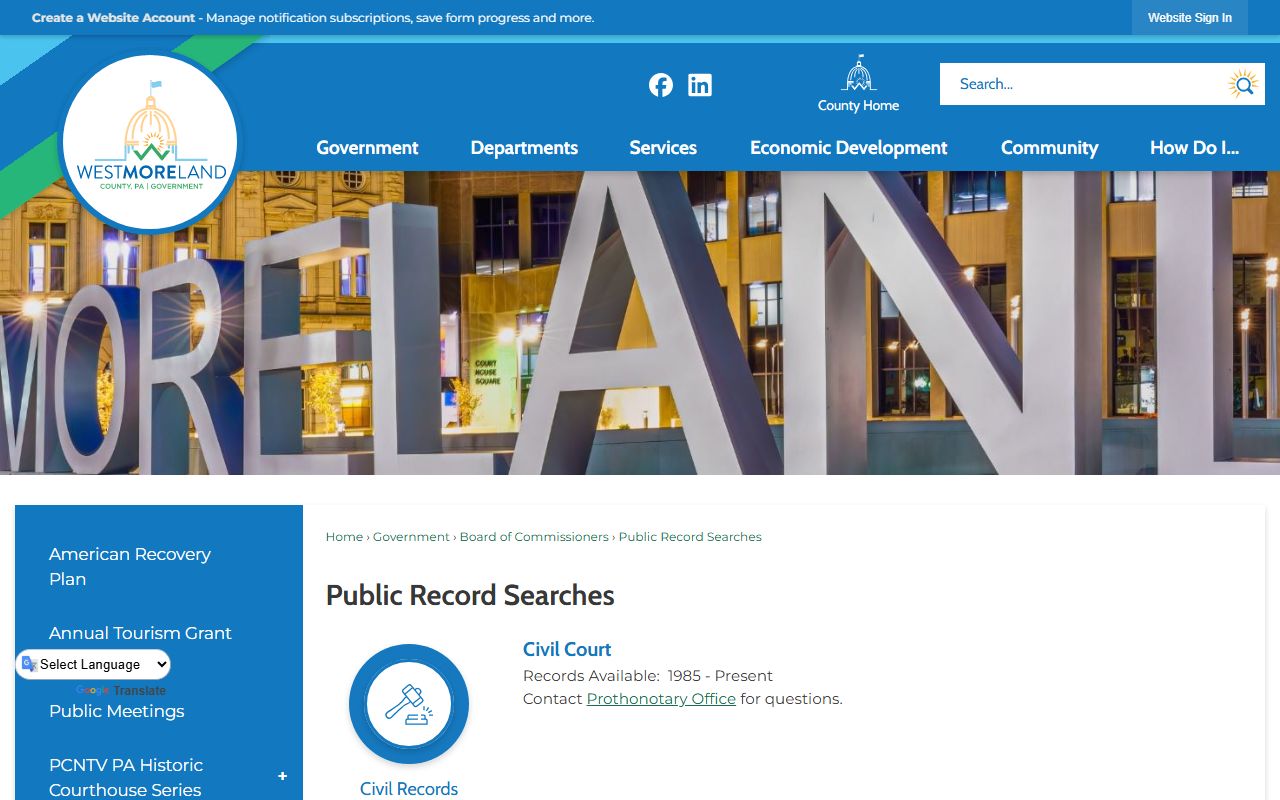
That hub is a good first stop when you are not sure which office holds the file. It routes you to the right system instead of a third-party site. For a deeper walk-through of the portal, see the Westmoreland County court records page.
The Case Search box changes its fields based on the search type you choose. These are the main fields a public user will see.
| Field Label | Type | Required | Notes / Format |
|---|---|---|---|
| Search By | Dropdown | Yes | Participant Name, Docket Number, Citation Number, Date Filed, OTN, and more. |
| County | Dropdown | Conditional | Set to Westmoreland for local results. |
| Docket Number | Text | Conditional | Full code, such as CP-25-CR-0009999-2017 or an MJ docket. |
| Citation Number | Text | Conditional | Includes a dash, for example A5368532-1. |
| Date Filed Range | Date | Conditional | mm/dd/yyyy; range limits apply. |
The Westmoreland County Judicial System
Westmoreland County is Pennsylvania's Tenth Judicial District. Its trial court of general jurisdiction is the Court of Common Pleas, which sits at the courthouse in Greensburg. This court hears felony criminal cases, large civil suits, family matters, juvenile cases, and Orphans' Court business. Below it sit the Magisterial District Courts, the local minor courts spread across the county.
A criminal case often begins in front of a magisterial district judge with a preliminary arraignment and a preliminary hearing. If the charges are held for court, the case moves up to the Court of Common Pleas. Small civil claims and landlord-tenant cases can start and finish at the magisterial level unless someone appeals.
Case flow: Magisterial District Court › Court of Common Pleas › Superior Court or Commonwealth Court › Supreme Court of Pennsylvania
| Court | Jurisdiction | Case Types |
|---|---|---|
| Supreme Court of Pennsylvania | Court of last resort | Final appeals; limited mandatory review |
| Superior Court of Pennsylvania | Intermediate appellate | Most civil and criminal appeals |
| Commonwealth Court | Intermediate appellate | Government and agency matters |
| Court of Common Pleas (10th District) | General trial court | Felonies, major civil, family, probate |
| Magisterial District Courts | Limited jurisdiction | Traffic, summary, small claims, landlord-tenant |
Pennsylvania explains this structure on its state courts site. The official overview of the Courts of Common Pleas describes how the general-jurisdiction trial courts are organized by judicial district.
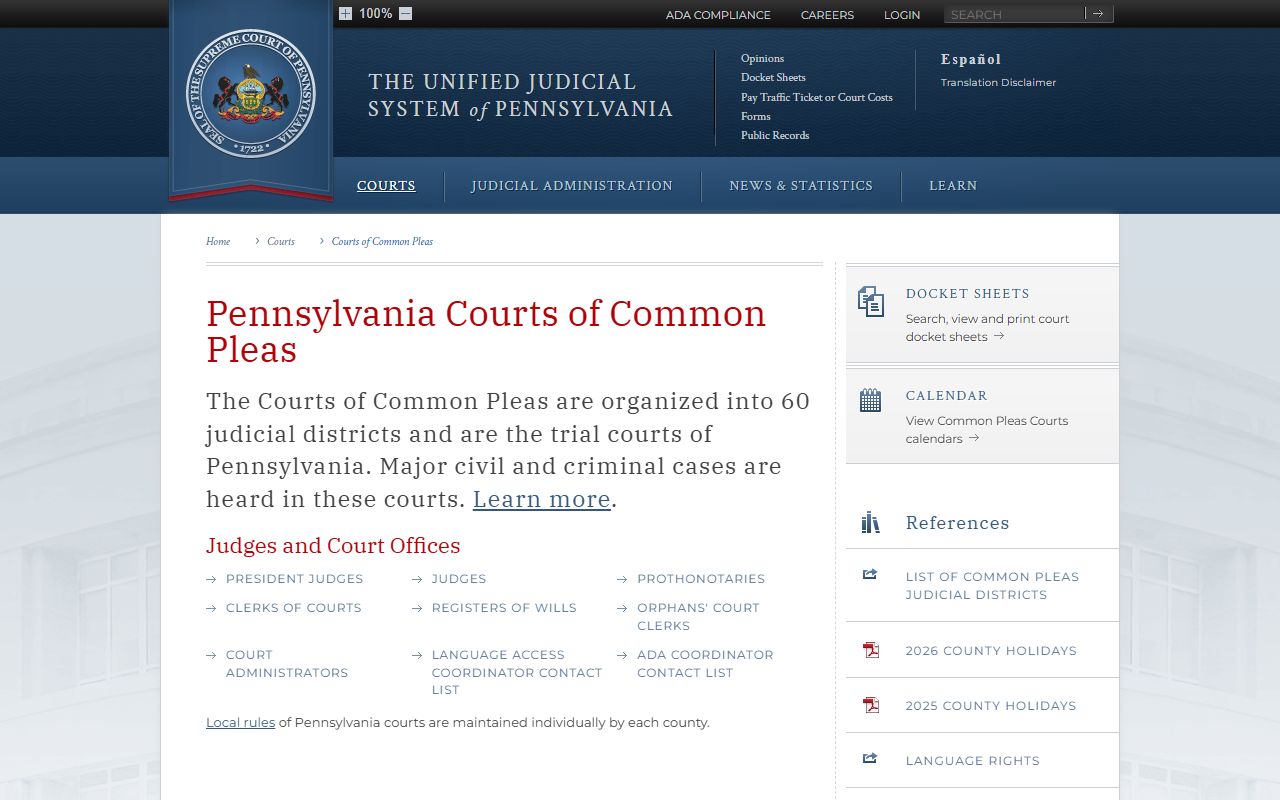
Knowing the level matters for your search. A traffic ticket and a felony may both be "Westmoreland County Court records," yet one lives in a magisterial docket and the other in a Common Pleas docket. The court dockets page breaks down each docket format.
Westmoreland County Courthouses and Offices
The Westmoreland County Courthouse anchors county government in downtown Greensburg. The Court of Common Pleas, Court Administration, and the elected record offices share the complex at 2 North Main Street. Because Pennsylvania splits records duties, the office you visit depends on whether your record is civil, criminal, or estate-related.
Westmoreland County Courthouse
2 North Main Street
Greensburg, PA 15601
724-830-3000
Clerk of Courts (Criminal)
2 N Main St, Suite 203
Greensburg, PA 15601
724-830-3734
Pennsylvania uses old row-office titles that confuse many out-of-county searchers. The Prothonotary is the civil clerk. The Clerk of Courts keeps criminal files. The Register of Wills and Clerk of Orphans' Court handles estates and marriage licenses. There is no single "county clerk" for every record here.
Types of Court Records Available in Westmoreland County
Westmoreland County court records fall into a few broad groups. Each group is tied to a court level and a record office. Public access depends on UJS policy, statute, and whether a file is sealed or restricted.
Most of these records appear in the same statewide portal, but a few must be requested from the office that holds the paper file.
- Criminal records - Common Pleas felony and misdemeanor cases kept by the Clerk of Courts.
- Civil records - complaints, judgments, liens, foreclosures, name changes, and divorces filed with the Prothonotary.
- Family and divorce records - divorce, custody, support, and protection-from-abuse matters, some of them restricted.
- Probate records - wills, estates, and guardianships at the Register of Wills and Orphans' Court.
- Traffic records - citations and summary offenses, usually heard in Magisterial District Court.
Divorce and other family files are handled on the civil side. The marriage and divorce records page covers how to find a decree and where to apply for a license.
What Westmoreland County Court Records Show
A public docket sheet is the heart of most Westmoreland County court records. It lists the case identity, the people involved, the events, and the result. Document images are usually summarized rather than offered for direct download. Sensitive data like Social Security numbers and victim addresses is redacted.
| Field | What It Shows |
|---|---|
| Case Number | Unique docket code; CP for Common Pleas, MJ for magisterial courts. |
| Filing Date | Date the case opened or was first docketed. |
| Parties | Plaintiff and defendant, or Commonwealth and defendant in criminal cases. |
| Charges / Cause | Offense, statute, and grade for criminal; claim type for civil. |
| Disposition | Result of each charge or the case as a whole. |
| Sentence / Judgment | Sentence, fines, costs, restitution, or money award. |
Compare the two main record types before you draw a conclusion. A docket can show a charge that was later dropped, so a filing is not the same as a conviction.
| Point | Court Record | Criminal History Check |
|---|---|---|
| Source | UJS docket from the clerk | State Police PATCH system |
| Shows | Court events and outcomes | Statewide conviction history |
| Cost | Free to view online | Fee-based request |
Public Access Laws for Westmoreland County Court Records
Pennsylvania uses two different rule sets. County administrative records follow the Right-to-Know Law. Court case records follow the judiciary's own public access policy and court rules. So a request for a county contract is not handled the same way as a request for a divorce decree.
Key Statutes:
Pennsylvania Right-to-Know Law, Act 3 of 2008 (65 P.S. § 67.101 et seq.) - sets a presumption that agency records are public unless an exemption applies.
UJS Public Access Policy (204 Pa. Code Ch. 213) - governs access to trial and appellate case records, redaction, and remote access.
18 Pa.C.S. § 9122 and the Clean Slate limited-access law - control expungement and the sealing of eligible criminal records.
42 Pa.C.S. § 6307 - restricts public access to juvenile court files.
The Office of Open Records hears many appeals over agency denials, but judicial records sit outside that path. For a sealed or limited-access case, you may need a court motion rather than a Right-to-Know request. The public records page explains both routes.
Records That Are Restricted or Confidential
Not every court file is open. Pennsylvania law and UJS policy pull several categories out of public view. Juvenile delinquency and dependency files are restricted. Expunged cases are removed. Clean Slate limited-access records do not show in the public portal. Adoption files are confidential. Mental-health and medical details stay protected even when a court was involved.
If you need a sealed record, you generally need court permission. A motion should name the case, identify the record, and explain the legal basis for access. A judge can grant redacted access instead of full release. To learn what is public on the criminal side, see the arrest records page.
Specialty Courts in Westmoreland County
Westmoreland County runs problem-solving courts that mix supervision with treatment. The Treatment Court serves defendants whose conduct is tied to substance use, pairing judicial oversight with testing, case management, and probation support. The Veterans Court coordinates court supervision with VA services, mentoring, and treatment for justice-involved veterans.
Neither program is automatic. A participant must meet local criteria and follow the program's rules, and serious or disqualifying history can rule a person out. Adult Probation is a key partner in both, monitoring testing, reporting, and court-ordered conditions.
Westmoreland County Sheriff and Jail
Sheriff James Albert leads the Westmoreland County Sheriff's Office, based in the courthouse basement at 2 North Main Street. The office handles civil process, real estate sales, prisoner transport, gun permits, and a warrant division. It is separate from the county prison, which holds people in custody.
The Westmoreland County Prison runs its own active inmate roster. The county notes that charges and bond do not appear on the roster itself and points searchers to UJS docket sheets for those details. For the full roster and how to read it, see Westmoreland County inmate records. For active warrant guidance, see warrant records, and for release verification see released inmates.
Marriage, Divorce, and Orphans' Court
Marriage licenses come from the Register of Wills and Clerk of Orphans' Court. Divorce is a civil matter filed through the Prothonotary. Estates, wills, and guardianships are Orphans' Court business. The county's estate records reach back to 1773. See marriage and divorce records and Orphans' Court records for details.
- Testator
- A person who makes a will.
- Executor
- The person named in a will to settle the estate.
- Intestate
- Dying without a valid will, so state law decides who inherits.
Which Office Holds Which Record
The split-office system is the single biggest source of confusion for Westmoreland County court records. A civil judgment and a criminal sentence live in different offices, under different clerks, even though both come from the Court of Common Pleas.
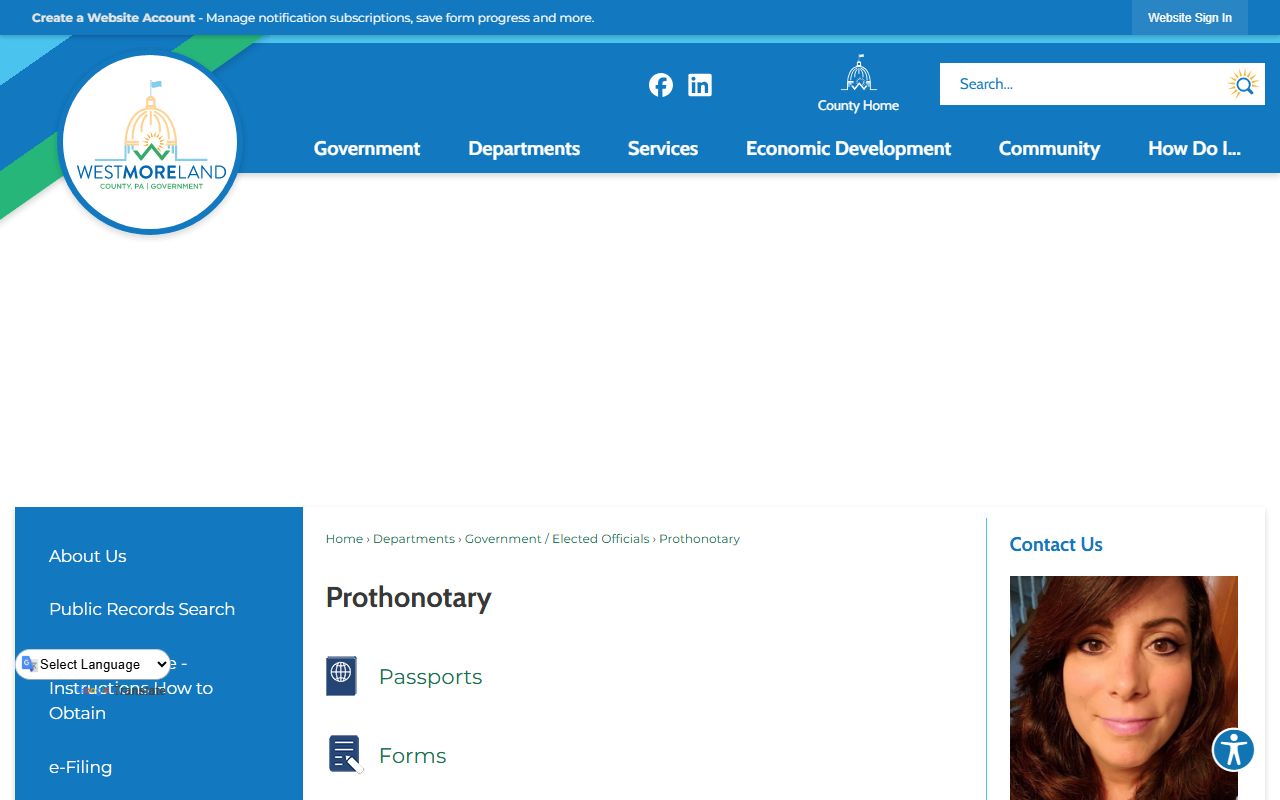
The Prothonotary page above lists civil filings, judgments, liens, divorces, and appeals. Criminal dockets sit with the Clerk of Courts instead, while wills and marriage licenses run through the Register of Wills. Matching the record to the office saves a wasted trip to Greensburg.
Westmoreland County Court Records Fees
Each record office sets its own copy and certification fees, and the county did not post a single combined fee sheet in the sources reviewed. Rather than guess at amounts, confirm the current fee with the office that holds your record before you mail a request or visit the counter.
| Fee Item | Where Set / How to Confirm |
|---|---|
| Prothonotary civil filings | Set by the Prothonotary; call 724-830-3502 to confirm. |
| Clerk of Courts criminal copies | Confirm with the Clerk of Courts at 724-830-3734. |
| Certified court copies | Usually per page plus a certification charge; confirm with the holding office. |
| Right-to-Know duplication | The Office of Open Records fee schedule controls administrative records. |
How to Interpret Westmoreland County Court Records
Docket language can be hard to read at first. A charge is an accusation, not proof of guilt. A disposition is the result. A case can be dismissed with prejudice, which blocks a refiling, or without prejudice, which leaves the door open. The letters OTN stand for offense tracking number, which links police and court records in Pennsylvania.
Watch the status field too. "Active," "closed," and "disposed" mean different things, and a blank result can simply mean the case is sealed, expunged, too old for the portal, or a civil Common Pleas matter that does not display online.
Accuracy and Record Limitations
Online dockets update on a schedule, not in real time. A recent filing, a new hearing, or a payment may not post the same day. The roster and the docket are kept by different systems, so they can disagree for a short window. When the answer matters for a job, a lease, or a court date, confirm it with the office of record.
Note: Always confirm a name, charge, or disposition with the originating Westmoreland County office before you rely on an online court record.
History of Westmoreland County Courts
Westmoreland County was created in 1773, one of the oldest counties in western Pennsylvania, with Greensburg as its seat. The courthouse has long served as the center of county government, holding the trial court, the row offices, and public business. Over time, paper docket books gave way to statewide UJS electronic dockets, while the county prison kept a legacy roster of its own. That history is why a single county can hold both very old estate files and modern online case data.
Frequently Asked Questions
How do I search Westmoreland County court records?
Use the Pennsylvania UJS Case Search or Docket Sheets tool. Pick a search type such as participant name, docket number, or citation number, and set the county to Westmoreland when the filter is available. For civil records not shown online, call the Prothonotary; for criminal records, contact the Clerk of Courts.
Why does the portal show no result?
UJS warns that juvenile cases, expunged cases, limited-access cases, and some Common Pleas civil cases may not display even with the right terms. Also check spelling, maiden names, business names, the docket format, and the county filter before you decide a case does not exist.
Is a court record the same as a background check?
No. A court docket shows what happened in a case. A statewide criminal-history check runs through the State Police PATCH system, which has its own coverage, fees, and rules. The two records can look different for the same person.
More on the Westmoreland County Court Records FAQ page.