
Arrest Records in Westmoreland County
An arrest record is made when police take a person into custody and book them. In Westmoreland County, the arresting agency can be a local police department, the State Police, or the Sheriff's Office. Booking creates the first official trail: a name, a date of birth, a booking number, and a commitment date. That data flows into the Westmoreland County Prison roster when the person is held. The roster is a live custody list, not a court judgment. It tells you who sits in the jail right now, when they came in, and which housing unit holds them.
Lead with the arrest, then trace the case. An arrest record shows that a person was taken in. A criminal court record shows what the court did with the charges after that. The two files come from different offices. Booking and roster data come from the jail. The full case history, with charges, pleas, and disposition, sits in the Court of Common Pleas docket kept by the Clerk of Courts. For that full case file, see the Westmoreland County court records page, which walks through the docket system in depth.
Treat the roster as a starting point. It is a custody snapshot. It is not proof of guilt, and it does not list the charges by itself.
How to Search Westmoreland County Arrest Records
There is no single arrest-blotter portal that ties everything together here. Recent arrests show up first on the county current-inmate search, because most arrested people who are held get booked into the prison. From there, the county sends you to the Pennsylvania Unified Judicial System for the charges and bond. The county is direct about this: the jail roster does not list charges, so the county points searchers to UJS docket sheets for that detail. So a complete lookup uses both tools in order.
- Open the county active-inmate search and look up the person by last name, commitment date, booking number, or unit.
- Note the booking number and commitment date from the roster row. These confirm a recent arrest and custody.
- Open the UJS docket-sheet search, pick a search type, and set the county to Westmoreland for a name lookup.
- Read the docket sheet for the charges, the grade, the bail, the hearings, and the disposition.
For a statewide picture, a name search on the UJS Case Search can surface older or out-of-county cases too. Set the county filter so a common name does not pull back the whole state. To find someone who is currently held and to read the roster fields, the Westmoreland County inmate records page covers the jail search step by step.
Arrest Records vs. Criminal Court Records
An arrest happens at booking. The court record begins when charges are filed and the case opens before a judge. A person can be arrested and never charged. A person can be charged and later cleared. The arrest record and the court record can tell different stories about the same event, so it pays to check both. The jail roster shows custody. The docket shows the legal result.
| Arrest Record | Criminal Court Record | |
|---|---|---|
| Source | Police, Sheriff, county prison roster | Clerk of Courts via UJS docket |
| Created When | Booking and commitment | Charges filed and held for court |
| Contents | Name, DOB, booking number, commit date, unit | Charges, bail, pleas, disposition, sentence |
Note: The county prison roster lists custody data only, so the official charge and bond detail must be read from the matching UJS docket sheet.
Charges vs. Convictions
Being charged is not the same as being found guilty. A charge is an accusation. A conviction is a guilty plea or a guilty verdict. A docket can show a charge that was later dropped, dismissed, or reduced. So a single arrest can lead to several charges, and only some may end in a conviction. Read the disposition line for each charge before you draw any conclusion about a person.
| Charge | Conviction | |
|---|---|---|
| Stage | Accusation at filing | Verdict or guilty plea |
| Burden of Proof | Probable cause | Beyond a reasonable doubt |
| Public Record | Yes, unless sealed | Yes, unless sealed or expunged |
The grade of an offense also matters. A charge can be a summary offense, a misdemeanor, or a felony, and the grade shapes the possible penalty. The docket lists the statute, the grade, and the disposition for each count.
Sealed vs. Expunged Records
Pennsylvania uses two ways to limit access to a criminal record. Limited access, also called Clean Slate, seals eligible cases so the public cannot see them in the court portal. Expungement is stronger; it removes eligible record information so it is treated as if it never existed. Serious violent offenses and many felony convictions do not qualify for routine sealing. A judge can deny relief if the waiting period is not met or court costs remain unpaid.
| Sealed (Limited Access) | Expunged | |
|---|---|---|
| Visibility | Hidden from public search | Removed, treated as never existed |
| Law Enforcement | Still visible to some agencies | Very limited retention |
| Eligibility | Nonconvictions and some misdemeanors after waiting periods | Certain summary offenses, ARD cases, and nonconvictions |
Sealing can happen on its own under Clean Slate, or by petition filed in the court of record. Expungement usually needs a petition under 18 Pa.C.S. § 9122. The Court of Common Pleas, where the case was decided, is the place to start. See the public-access notes on the court records page for how restricted files are handled.
Mugshots and Booking Photos
The Westmoreland County Prison roster does not post a mugshot. The public result list shows the name, date of birth, booking number, commitment date, and a single-letter housing unit. It does not show a photo, a physical description, the arresting agency, or the charges. So if you are hunting for a booking photo, the county roster will not give you one.
Mugshots in Pennsylvania can be limited. Police agencies do not always release booking photos to the public, and access can depend on the case and the agency. Avoid third-party mugshot sites. They often charge fees, post stale data, and are not official. Stick to the county and state systems, which are free and current.
Statewide Criminal Records Search
For a statewide criminal history, the official tool is the Pennsylvania State Police PATCH system. PATCH stands for Pennsylvania Access To Criminal History. It returns conviction-level history across the state, not just one county. A court docket and a PATCH check can look different for the same person, because they have different coverage and rules. PATCH is fee-based and asks for identity and purpose information when you request a check.
You can learn how the request works on the State Police background-check page.
The Pennsylvania State Police explain the process on the official criminal-history background-check page, which describes who can request a check and what a result covers.
That page is the gateway for a formal statewide history check. The actual searches run through the PATCH web portal.
You submit and pay for a request through the PATCH criminal-history portal, where the State Police host the online history system.
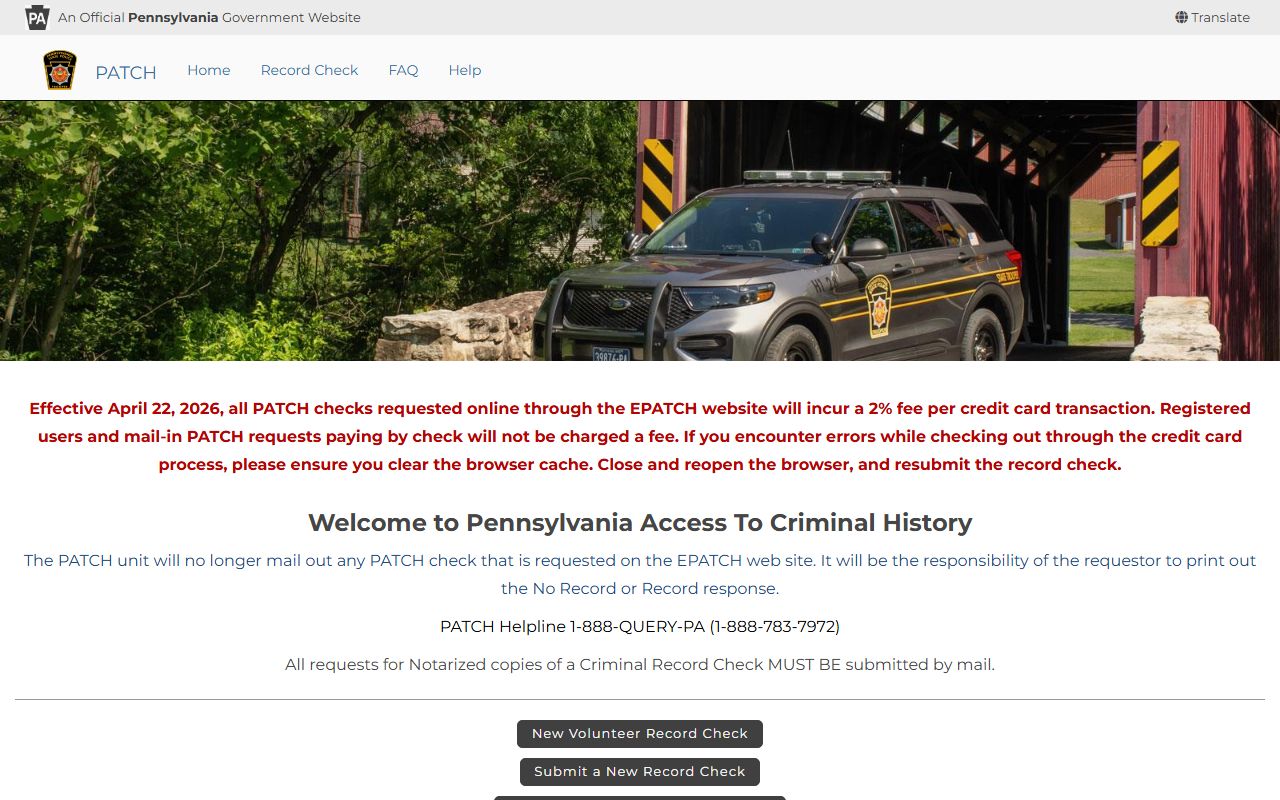
PATCH is the right tool when you need a formal background result rather than a single case docket. For one case, the UJS docket is faster and free.
Who Handles Westmoreland County Criminal Cases
The Westmoreland County District Attorney prosecutes county criminal cases. Nicole W. Ziccarelli is the District Attorney, and her office investigates and prosecutes crime while working to protect crime victims. The District Attorney's office page lays out that mission. The county Detective Bureau supports investigations with forensic services.
The county recently expanded its forensic capacity, which is current news tied to arrest and prosecution work.
The county's forensic-services initiative is described on the official DA Detective Bureau forensic services page, posted as part of the bureau's public-feedback effort.
On the defense side, the Public Defender, Wayne P. McGrew, represents financially eligible defendants in qualifying criminal and juvenile cases. People charged with a crime who cannot afford a lawyer can apply to that office. Federal prosecutions, when they happen, are handled separately by federal authorities for the region.
Some Westmoreland County arrests lead to federal charges rather than county charges.
Federal prosecution context for the region comes through the U.S. Attorney's Office for the Western District of Pennsylvania, which handles federal criminal matters that arise in the area.
So a single arrest can route to county court, federal court, or both. The roster and the county docket cover the county side, while federal custody and cases use separate federal tools.
Background Check Considerations
A casual lookup and a formal background check are not the same. A free UJS docket search tells you about one case. An employer, a landlord, or a licensing board often needs a formal report that follows the law. For a regulated check used in hiring or tenant screening, the Fair Credit Reporting Act sets strict rules on accuracy, consent, and dispute rights. A formal statewide criminal-history result runs through PATCH, not a casual web search.
Match the tool to the purpose. Use the jail roster to confirm custody, UJS to read a case, and PATCH for a statewide history check.
Important: This privately operated site is not a consumer reporting agency under the FCRA, and its information may not be used for credit, employment, tenant, or insurance decisions.
Restricted Criminal Records in Westmoreland County
Not every arrest or case is open to the public. Juvenile delinquency and dependency records are restricted under Pennsylvania law and are not treated like ordinary adult dockets. Expunged cases are removed from public view. Clean Slate limited-access cases do not display in the UJS portal. Sealed warrants and active investigation files can also stay out of public reach.
So a blank search result does not always mean no record exists. The case may be sealed, expunged, juvenile, too old for the portal, or filed under another name. For active-warrant questions, see the Westmoreland County warrant records page. For traffic and summary matters, the traffic court records page covers citations heard in the local magisterial courts.