
What Is a Court Docket in Westmoreland County
A docket is a chronological list of a case's filings and events. It records each motion, order, hearing notice, continuance, plea, and disposition in the order they happened. A Westmoreland County docket sheet shows the case identity at the top, the parties and attorneys, the charges or claims, the scheduled events, and the money owed. It is the spine of the case. The full case file holds the actual documents, while the docket is the index that points to them.
Docket sheets carry a docket number that signals the court level. The prefix tells you a lot at a glance. Common Pleas dockets begin with CP. Magisterial District Court dockets begin with MJ. Appellate dockets use their own formats, such as a number followed by WDA for the western appellate region. The county code for Westmoreland is 25 on Common Pleas dockets, and judicial district 10 on magisterial offices.
Document images are usually not open for direct download from a public docket sheet. The sheet summarizes the activity instead. To pull the underlying motion, order, or transcript, you often need a clerk request or an in-person visit. The docket tells you what exists. The clerk gives you the paper.
The docket-number format is worth learning, because it is the fastest way to spot the court level and pull an exact case. Each part of the number carries meaning.
- CP prefix
- A Court of Common Pleas docket, such as CP-25-CR-0009999-2017, where 25 is the county code and CR marks a criminal case.
- MJ prefix
- A Magisterial District Court docket that includes the MDJ office code, the docket type, a sequence number, and the year.
- OTN
- The offense tracking number that links a person's police and court records across Pennsylvania.
- Citation number
- A traffic or summary citation code that contains a dash, for example A5368532-1.
How to Find Westmoreland County Dockets Online
The free statewide tool is the Pennsylvania Unified Judicial System portal. Use the UJS Docket Sheets tool when you want a docket sorted by court level, or the UJS Case Search for a broad lookup by name, citation, or OTN. Both cover Common Pleas and magisterial cases for Westmoreland County. Set the county filter so a common name does not return the whole state.
- Open the UJS Docket Sheets or Case Search tool on the Pennsylvania courts portal.
- Pick the court type or the search mode, such as Participant Name, Docket Number, or Citation Number.
- Enter the name or the full docket number, and set the County field to Westmoreland for a name search.
- Open the matching docket and review the entries from top to bottom, including hearings and disposition.
A docket number is the most precise input you can use. If you only have a name, expect a list and use the date or party role to find the right case. For traffic matters, a citation number works well, and the citation includes a dash, like A5368532-1. You can also search by attorney, organization, or OTN when those fit what you have.
The county also keeps its official record links in one place. The Westmoreland County public record search hub routes you to the court, deed, assessment, and inmate systems, which helps when you are unsure which system holds the docket you want. It points to UJS for the court side rather than to any third-party site.
Note: Juvenile, expunged, limited-access, and some Common Pleas civil dockets may not display in the public portal even with correct search terms.
Sample Westmoreland County Docket Entry
A docket sheet groups its data into sections. The header gives the case identity. The middle holds parties, charges, and events. The bottom carries financials. The table below maps the fields seen on a typical public UJS docket sheet and what each one tells you.
| Field | What It Shows |
|---|---|
| Docket Number | Case code with a CP or MJ prefix that signals the court level. |
| Court / County | Court of Common Pleas or Magisterial District Court; Westmoreland when filtered. |
| Case Caption | Commonwealth v. defendant for criminal; plaintiff v. defendant for civil. |
| Filing Date | Date the case opened or was first docketed. |
| Case Status | Active, closed, inactive, or disposed. |
| Parties / Attorneys | Names, roles, and counsel of record where entered. |
| Charges | Statute, grade, description, and disposition for criminal and traffic cases. |
| Bail / Bond | Bail type and amount where public. |
| Calendar Events | Hearing date, time, room, event type, and judge where entered. |
| Docket Entries | Each filing or event with date, entry text, and sequence. |
| Financial Section | Fines, costs, restitution, payment plan, and balance where shown. |
Redactions apply throughout. Social Security numbers, full birth dates in some contexts, victim and minor data, and sealed entries are not shown. A sealed or limited-access case may return no result at all.
Courts That Publish Dockets in Westmoreland County
Westmoreland County is Pennsylvania's Tenth Judicial District. Two trial-court levels feed the public docket system, and both post to UJS. The general trial court is the Court of Common Pleas in Greensburg. Below it sit the Magisterial District Courts spread across the county. Appellate dockets come from the state appeals courts when a case moves up.
- Court of Common Pleas (10th District) - felony criminal, major civil, family, and Orphans' Court dockets; criminal dockets sit with the Clerk of Courts.
- Magisterial District Courts - traffic, summary offenses, small claims, landlord-tenant, and preliminary criminal dockets.
- Superior, Commonwealth, and Supreme Courts - appellate dockets for cases that move up from Westmoreland County.
Not all docket data is fully public online. UJS notes that some Common Pleas civil information does not display even when a courthouse record exists. For those, the Westmoreland County court records page covers the in-person request route through the clerk offices.
The court level also shapes how a case flows. A criminal case often opens at a magisterial office with a preliminary arraignment and a preliminary hearing. If the charges are held for court, the case moves up to the Court of Common Pleas, and the criminal docket then sits with the Clerk of Courts. Small civil claims and landlord-tenant cases can start and end at the magisterial level unless someone appeals. So a single matter may produce both an MJ docket and a CP docket as it climbs.
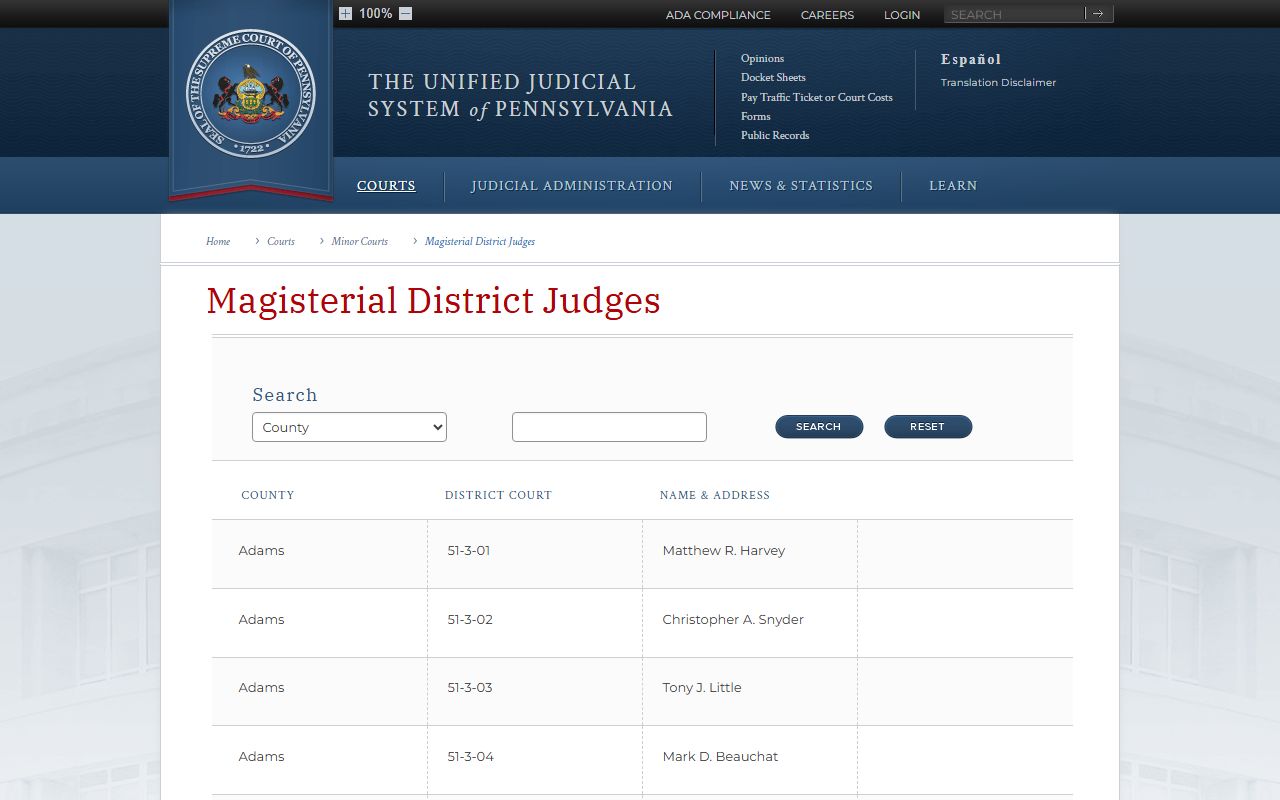
The state magisterial district judge page shown above lists the minor-court offices and judges. Each office handles the MJ dockets for its area, and the Court of Common Pleas page maps every Westmoreland office with its address and phone.
Docket vs. Full Case Record
People mix up the docket and the case file, but they are not the same thing. The docket is a list of entries that track the case. The full case record holds the actual documents, such as motions, exhibits, orders, and transcripts. You read the docket to follow the case. You pull the file to see the paper behind it.
| Docket | Full Case Record | |
|---|---|---|
| Format | List of entries | Full documents |
| Access | Often online and free | May require a fee or a visit |
| Where It Lives | UJS public portal | Prothonotary or Clerk of Courts |
| Use | Track case progress | Legal review and evidence |
For inmate charges and bond, the county roster sends you to UJS docket sheets, since the roster itself does not list those details. Start with the Westmoreland County inmate records roster to confirm a name and booking number, then open the docket for the charge and bail.
How to Read a Westmoreland County Docket
Docket language can be hard at first. A charge is an accusation, not proof of guilt. A disposition is the result. A case can be dismissed with prejudice, which blocks a refiling, or without prejudice, which leaves the door open. The letters OTN stand for offense tracking number, the code that links police and court records in Pennsylvania. A continuance simply means a court event was moved to a later date.
Watch the status field and the entry sequence. "Active," "closed," and "disposed" mean different things, and the entries run in date order so you can trace the case from filing to result. A blank result is not always a dead end. The case may be sealed, expunged, too old for the portal, filed under a business name, or a civil Common Pleas matter that does not display online.
Online dockets also update on a schedule, not in real time. A recent filing, a new hearing, or a payment may not post the same day it happens. The county prison roster and the UJS docket are kept by separate systems, so they can disagree for a short window. Treat the docket as a strong lead, then verify the detail that matters with the office that holds the file.
When the answer matters for a job, a lease, or a court date, confirm it with the office of record. The traffic court records page covers citation dockets, and the arrest records page covers the criminal side. For the civil clerk, see the Prothonotary page.